How to Build a Photography Portfolio
- Build a portfolio for one reader and one purpose
- Translate the requirement into a checklist
- Gather wide, then remove duplicates
- Choose evidence, not categories
- Sequence the photographs as a visual argument
- Write captions that can be trusted
- Prepare the files without sacrificing the work
- Finish with a compliance pass
Build a portfolio for one reader and one purpose
To build a photography portfolio, define the opportunity, follow its exact submission rules, gather more eligible images than you need, and edit for a coherent point of view rather than maximum variety. Sequence the selected work, add concise accurate captions, test the presentation on the intended device or print format, and ask reviewers what the pictures communicate before explaining your intention.
A college application, editorial pitch, assistant role, gallery review, and wedding inquiry need different evidence. One universal portfolio usually becomes a suitcase packed for every climate and useful in none.
Translate the requirement into a checklist
Copy the current instructions from the school, employer, grant, client, or review organizer. Record:
- number of images or projects;
- file type, dimensions, color space, and size limit;
- naming and upload order;
- caption or statement requirements;
- eligibility and date restrictions;
- collaborative-work credit rules; and
- deadline, time zone, fee, and confirmation process.
Do not assume last year's requirements survived. Ask the receiving organization when an instruction is ambiguous, and keep its answer. Submit only work you are authorized to show, with subjects' privacy, consent, location sensitivity, and contractual restrictions respected.
Gather wide, then remove duplicates
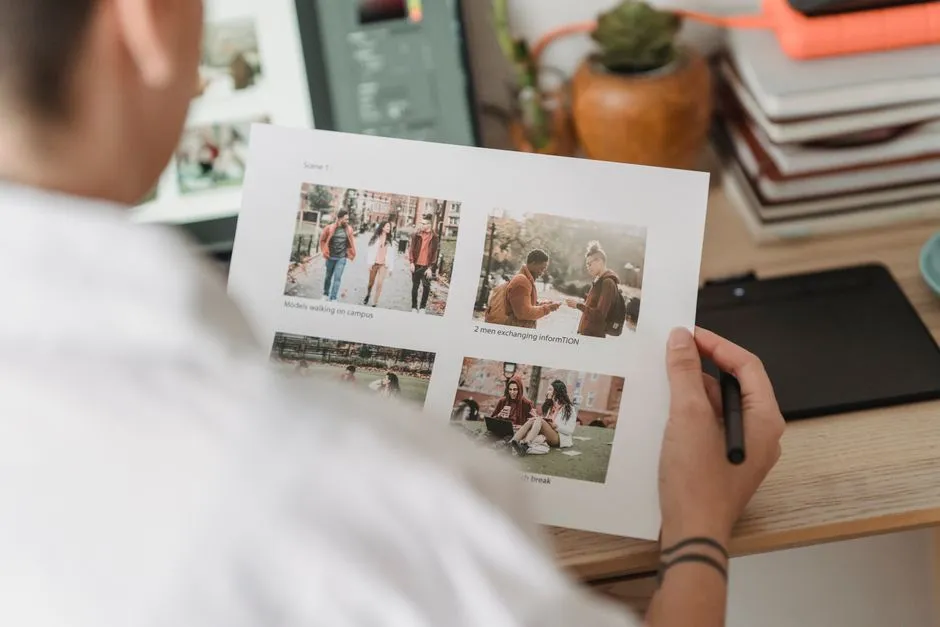
Create a working pool two or three times larger than the final count. Include technically sound photographs and a few imperfect frames whose idea or emotional force deserves discussion. Make small prints or uniform thumbnails so fame, file size, and screen brightness cannot lobby separately.
Group near-duplicates. Keep the frame that best supports the sequence, not every microvariation that proves the burst mode functioned. Remove images that repeat the same composition, gesture, or visual conclusion without adding information.
Browse Portfolio Work for more editing and presentation methods.
Choose evidence, not categories
For each remaining image, finish these sentences:
- This belongs because it shows…
- It adds something no other selected image adds, which is…
- A reviewer may remember it for…
Strong portfolios often show sustained attention, decisions, and development. Variety can help when the opportunity asks for range, but unrelated “best shots” may demonstrate several skills without revealing how you think. A coherent series does not require every picture to look identical. It needs a relationship the viewer can feel and describe.
For commercial work, lead with images relevant to the client and show consistent execution across a realistic assignment. For study applications, follow the program's stated priorities; process work, experimentation, or multiple media may matter when explicitly requested. Never guess that one admissions formula applies everywhere.
Sequence the photographs as a visual argument
Lay out all finalists and choose an opening image that establishes attention without exhausting the loudest surprise. Follow visual relationships: direction of gaze, shape, color, distance, subject, mood, or cause and effect. Separate two similar frames if comparison weakens both; place them together when the echo creates meaning.
The middle should deepen or complicate the initial promise. The final image should close, release, or deliberately leave a question. It need not be the “second-best” photograph under a mysterious Olympic scoring system.
Test several orders. Show the sequence silently to a reviewer and ask where the project began, changed, dragged, and ended. If you must narrate every connection before they see one, the captions may be doing unpaid structural labor.
Write captions that can be trusted
Use the requested format. A basic caption may include title, year, location when safe and relevant, medium or process, and dimensions for a physical work. Identify collaborators and distinguish your role. For documentary images, verify names, places, dates, and context with care; do not invent a cleaner story.
Keep a project statement concrete: what you photographed, how and over what period you worked, what question guided the edit, and what changed through the process. Avoid announcing universal human truths that the pictures cannot reasonably carry.
The guide to whether a photography degree is worth it explains how a short portfolio project can reveal which educational resources you genuinely need.
Prepare the files without sacrificing the work
Export copies from preserved master files. Follow required pixel dimensions, file format, color profile, and maximum size exactly. Use consistent filenames and verify that compression has not created banding, halos, or mushy detail. Test the gallery on a phone and computer, with ordinary connections and alt text where the platform supports it.
For print, make test prints, view them under relevant light, and allow time for reprints. Protect surfaces and use archival materials only when the requirement or intended longevity calls for them; confirm material claims with manufacturers rather than assuming every sleeve is conservation-grade.
Back up masters and the final submitted set in more than one location. Never overwrite the only high-resolution file while making a tiny upload version. That is less a workflow than a suspense film with no enjoyable ending.
Finish with a compliance pass
Count the images, open every file, check captions against filenames, test links in a signed-out browser, and review the submission receipt. Ask one trusted reviewer for the weakest image, the strongest relationship, and anything that seems out of place.
Then submit the edited portfolio rather than adding one last unrelated favorite at 11:58 p.m. Restraint is part of the work. A portfolio succeeds when the viewer can see what you notice, how you make decisions, and why these photographs belong together now.